





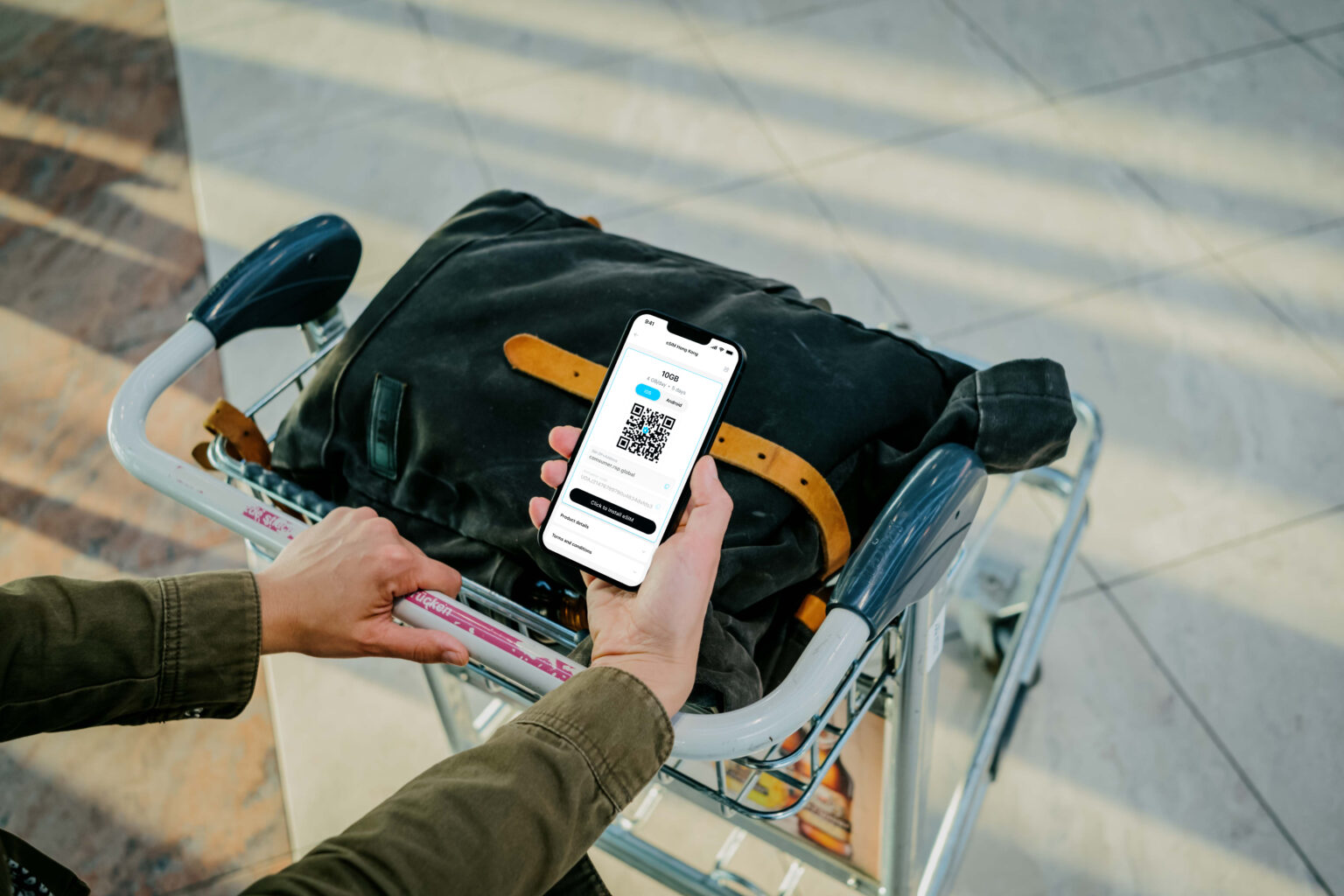
Planning a trip to Vietnam in late 2025 or early 2026? Whether you are riding a GrabBike through Hanoi, cruising Ha Long Bay, or watching the sunset over the rice terraces in Sa Pa, staying connected matters more than ever.
Mobile internet is no longer just a nice extra when you travel. You use it for Google Maps, ride-hailing apps, food delivery, banking codes, and keeping in touch with family back home. In Vietnam, a stable connection makes everyday travel much easier.
Because of that, many travelers now skip airport SIM counters. Waiting in line, dealing with language barriers, or paying unclear tourist prices is no longer worth the hassle. eSIMs offer a simpler way to get online.
An eSIM is a digital SIM that installs directly on your phone. There is no physical card to swap. You can set it up before your flight and connect to local networks as soon as you land.
By the end of 2025, Vietnam has more eSIM options than ever. Some work better than others depending on where you travel and how much data you need. This guide explains how eSIMs work in Vietnam today, what to look for when choosing one, and which providers offer the best balance of coverage, value, and reliability.
I. Why Use an eSIM for Your Vietnam Trip in Late 2025?
Arriving in a new country used to mean looking for Wi-Fi or lining up at a SIM counter. In late 2025, most travelers prefer to get connected without wasting time at the airport.
That is where eSIMs come in.
An eSIM lets you go online as soon as you land in Vietnam. There is no need to search for a SIM shop, explain what you need, or worry about closing hours at the airport.
Here are the main reasons travelers now choose eSIMs when visiting Vietnam.
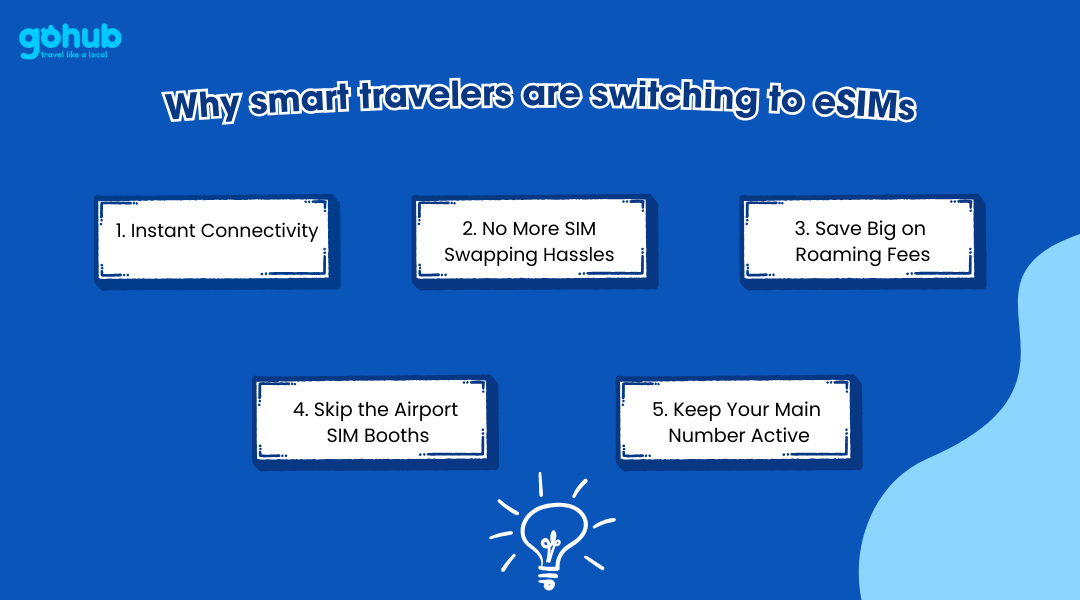
1. You are connected the moment you land
With an eSIM, your data plan is installed before your trip. When your plane lands in Hanoi, Da Nang, or Ho Chi Minh City, your phone connects automatically. You can open Google Maps, book a Grab, or message your hotel right away.
2. No physical SIM swapping
You do not need to remove your home SIM or carry a SIM ejector tool. Everything is managed in your phone settings. Switching between your regular number and your Vietnam data line takes only a few taps.
3. No roaming bill surprises
International roaming can be expensive and unpredictable. eSIMs connect you to local Vietnamese networks, so you pay local data rates. This is often much cheaper than using roaming from your home carrier.
4. Reliable coverage beyond big cities
Vietnam’s main mobile networks cover more than just major cities. With the right eSIM, you can stay connected in places like Sa Pa, Ha Giang, Phong Nha, or the Mekong Delta. Public Wi-Fi in these areas is often slow or unstable.
5. Keep your main number active
Most modern phones support dual SIM. This means you can keep your main number active for calls or banking codes while using the eSIM for mobile data.
If you plan to visit more than one country in Southeast Asia, some eSIMs also offer regional plans. These let you stay connected across borders without changing SIMs during your trip.
II. How to Choose the Best eSIM for Vietnam
Choosing the right eSIM makes your trip easier. A good eSIM lets you stay online without surprises. Below are the key things to consider before you buy.
1. Network Coverage
Vietnam has several mobile networks. The biggest ones are Viettel, Vinaphone, and Mobifone. A good eSIM plan should connect you to one of these networks.
Why this matters
Big networks usually offer better signal in both cities and rural areas. That means you can stay connected in Hanoi, Ho Chi Minh City, Da Nang, and even small towns like Sa Pa or Ha Giang.
2. Trip Length
Think about how long you will stay. Some eSIM plans are perfect for short trips. Others work better for a month or more.
Match your plan to your trip length.
For a weekend in Ho Chi Minh City, a small data plan may be enough. If you are traveling for weeks, choose a plan with more data and longer validity.
3. Data Allowance
Ask yourself how much data you need on the road.
- Light use: email, maps, messaging
- Medium use: social media and videos
- Heavy use: uploading photos, video calls, streaming
Choose a plan with data that fits your needs. Too little data can leave you offline at the wrong time.
4. Price and Value
Price is important, but value matters more.
Don’t just look at the lowest number. Check how much data you get and whether hotspot sharing is included. Hotspot sharing lets you connect other devices like a laptop.
A good plan balances price, data, and features.
5. Setup and Ease of Use
The best eSIMs are easy to install.
Most plans give you a QR code you scan before you travel. Others let you install via an app. Some require identity verification, and others do not.
If you want an easy start, look for plans that install quickly without extra steps.
6. Device Compatibility
Not all phones support eSIMs.
Before buying, check if your phone:
- Is unlocked
- Has eSIM support
Most newer iPhones, Samsung Galaxy models, and Google Pixels support eSIMs.
7. Phone Calls and SMS
Some eSIM plans only offer data. That means you can use apps like WhatsApp or Messenger for calls.
If you need a local phone number for calls or SMS, check whether the eSIM plan includes voice support.
8. Customer Support
Things don’t always go perfectly. Good customer support helps when you need it.
Look for 24/7 support through chat or app. This is especially helpful if you arrive late or travel across time zones.
Quick Checklist Before You Buy
✔ Does the eSIM connect to a strong local network?
✔ Is the data amount right for your trip?
✔ Does the plan match your trip length?
✔ Can you use hotspot sharing?
✔ Is it easy to install?
✔ Does your phone support eSIM?
✔ Do you need voice/SMS or just data?
✔ Is customer support available if needed?
III. Top eSIM Providers for Vietnam (Pricing-Led Comparison, Late 2025)
When comparing eSIMs for Vietnam, price alone can be misleading. What matters more is how data is priced, how it is consumed, and whether the plan fits real travel behavior.
Below are the most relevant eSIM providers for Vietnam as of late 2025, ranked by pricing structure and practical value.
1. Gohub – Best Value for Daily High Usage
Gohub stands out because of its daily data pricing model. Instead of selling one fixed data pool, some plans offer high data each day, which resets daily.
This works especially well for travelers who rely on mobile internet throughout the day. Maps, ride-hailing, social media, uploads, and video calls all fit comfortably without worrying about running out of data too early.
Another practical advantage is that certain plans include a Vietnamese phone number with call and SMS, which is still useful in Vietnam for hotels, tour operators, and local services.
Why the pricing works
- High data allowance per day
- Predictable usage without data rationing
- Competitive cost for trips around 7 to 14 days
- No KYC required
Best for
Travelers who want simple pricing, strong daily data, and a ready-to-use local setup.
| 🔍 Feature | 📝 Details |
|---|---|
| Where it works | 🇻🇳 Nationwide – From Hanoi to Ho Chi Minh City & Phu Quoc |
| Pricing model | Daily data plans (GB per day) |
| Plans from | From ~$7.59 for 10 days |
| Data structure | High daily data allowance (resets every day) |
| Network | Mobifone (local carrier) |
| Local phone number | ✅ Yes (selected plans) |
| Call & SMS | ✅ Included on supported plans |
| Hotspot sharing | ✅ Yes |
| KYC required | ❌ No |
| Activation method | QR code installation |
| Best for | Travelers who want predictable daily data, simple pricing, and a local-ready setup |

2. Airalo – Simple Fixed Data Packages
Airalo uses a fixed total data model, such as 1GB, 3GB, or 10GB for a set number of days. This structure is easy to understand and works well for light or moderate usage.
However, because all data comes from one shared pool, travelers need to manage usage carefully, especially on longer trips.
Pricing characteristics
- Fixed total data caps
- Higher price per GB compared to local-focused plans
- Reliable performance on major Vietnamese networks
Best for
Short trips and travelers who prefer a familiar global brand with straightforward pricing.
3. Holafly – Unlimited Data with Higher Daily Cost
Holafly prices its Vietnam eSIMs based on trip length, offering unlimited data during that period. This removes the need to track data usage, which many travelers find convenient.
That said, unlimited plans usually come with fair usage policies. Heavy users may experience reduced speeds after reaching a certain daily threshold.
Pricing characteristics
- Higher daily cost
- No visible data cap
- Possible speed reduction after heavy use
Best for
Travelers who want peace of mind and do not want to think about data limits.
4. Nomad – Balanced Price per GB
Nomad sits between premium and budget options. Its Vietnam eSIMs use fixed data bundles but are often priced more competitively than large global brands.
The pricing works well for travelers who know roughly how much data they need and want flexibility without paying a premium.
Pricing characteristics
- Reasonable cost per GB
- Multiple plan sizes
- No local phone number
Best for
Digital nomads and cost-aware travelers who want reliable data without overpaying.
5. GigSky – Convenient for Multi-Country Trips
GigSky’s pricing is designed for travelers visiting multiple countries. While its Vietnam-only value is not the cheapest, the convenience of keeping one eSIM across borders can outweigh the cost.
Pricing characteristics
- Moderate pricing
- Works across Vietnam and other countries
- Value comes from flexibility, not lowest cost
Best for
Travelers combining Vietnam with other destinations in the same trip.
Pricing Summary
- Daily data plans offer the most predictable value for active travelers.
- Fixed data bundles work best for short or light-use trips.
- Unlimited plans reduce mental overhead but usually cost more per day.
- Multi-country eSIMs trade price for convenience.
IV. Best Vietnam eSIM Plans at a Glance (Pricing Comparison)
After looking at how each provider structures its pricing, it helps to see everything side by side. This quick comparison focuses on pricing model, data structure, and real travel value, not marketing claims.
Vietnam eSIM Pricing Comparison (Late 2025)
| Provider | Pricing Model | Typical Entry Plan | Data Structure | Local Number | KYC Required | Best For |
|---|---|---|---|---|---|---|
| Gohub | Daily data (GB/day) | ~$7.59 / 10 days | High data resets daily | ✅ Yes (selected plans) | ❌ No | Predictable daily usage, short–mid trips |
| Airalo | Fixed total data | ~$4.50 / 1GB | One shared data pool | ❌ No | ✅ Yes | Light users, short stays |
| Holafly | Unlimited (per day) | ~$6.90 / day | Unlimited with fair use | ❌ No | ❌ No | Heavy users, no data tracking |
| Nomad | Fixed total data | ~$4.00 / 1GB | Shared data bundle | ❌ No | ❌ No | Budget-aware travelers |
| GigSky | Regional/global plans | ~$4.99 / 1GB | Shared across countries | ❌ No | ❌ No | Multi-country itineraries |
How to Read This Table
If you are deciding quickly, here is a simple way to choose:
- Choose daily data plans if you use maps, ride-hailing, social media, or video calls every day.
- Choose fixed data bundles if you mainly message and browse lightly.
- Choose unlimited plans if you do not want to think about data at all, even at a higher cost.
- Choose multi-country plans only if Vietnam is part of a larger trip.
V. How to Set Up and Use an eSIM in Vietnam (Step-by-Step)
Setting up an eSIM is simple, but doing it in the right order helps avoid problems when you arrive. Follow these steps and you will be online within minutes.
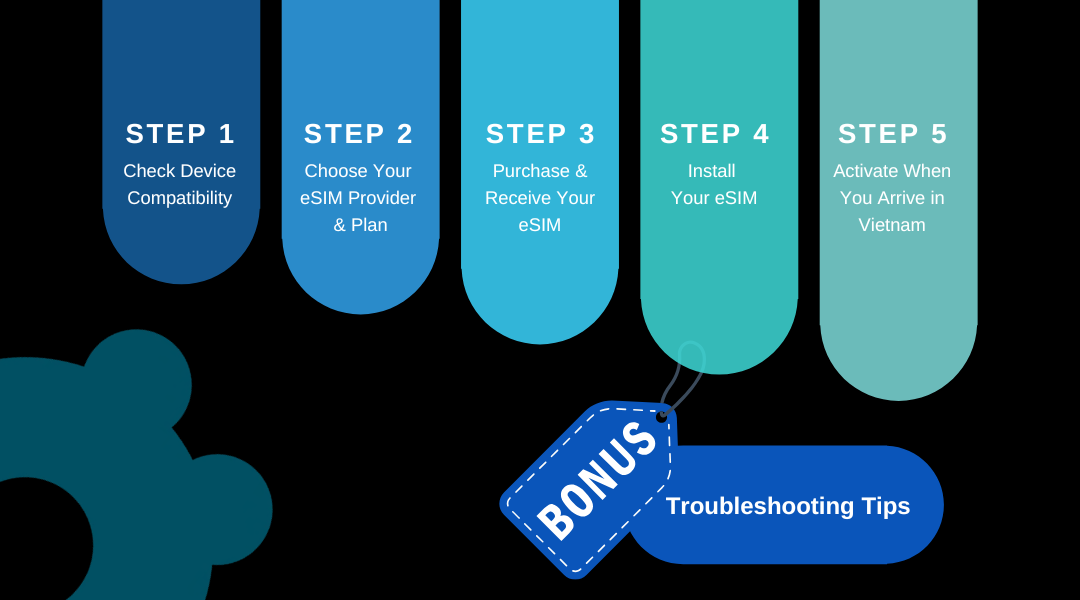
Step 1. Check if your phone supports eSIM
Before buying any plan, make sure your phone:
- Supports eSIM
- Is unlocked
Most newer iPhones, Samsung Galaxy phones, and Google Pixel devices support eSIM.
If your phone is locked to a carrier, the eSIM will not work.
Step 2. Buy your eSIM before you travel
It is best to purchase your eSIM while you still have stable Wi-Fi at home.
After checkout, you will usually receive:
- A QR code by email
- Or access through the provider’s app
Save the QR code or take a screenshot in case you need it later.
Step 3. Install the eSIM on your phone
You can install the eSIM before your flight. This does not activate the data yet.
On iPhone
- Go to Settings
- Tap Cellular
- Choose Add eSIM
- Scan the QR code
- Follow the on-screen steps
On Android
- Go to Settings
- Tap Network or SIMs
- Choose Add eSIM
- Scan the QR code
- Complete setup
Name the eSIM something like “Vietnam eSIM” so it is easy to find later.
Step 4. Activate the eSIM when you arrive in Vietnam
Once you land:
- Turn on the eSIM
- Set it as your mobile data line
- Enable data roaming
Your phone should connect to a local network within a few seconds.
Step 5. Test your connection
Open Google Maps or a website to confirm everything works.
If the connection does not start:
- Restart your phone
- Check that mobile data is turned on
- Make sure the eSIM is selected for data
Common Setup Mistakes to Avoid
- Activating the eSIM too early
- Forgetting to turn on data roaming
- Deleting the eSIM before the trip ends
If something goes wrong, most providers offer live chat support to help you fix it quickly.
VI. eSIM vs Airport SIM vs Roaming in Vietnam
Travelers in Vietnam usually have three ways to get mobile internet. Each option works, but the experience can feel very different depending on how you travel.
Here is a simple comparison to help you decide.
eSIM
eSIMs let you connect without handling a physical SIM card. Everything is set up digitally.
Pros
- Ready to use as soon as you land
- No SIM swapping
- Can be installed before your trip
- Easy to manage in phone settings
Cons
- Requires an eSIM-compatible phone
- Some plans are data-only
Best for
Travelers who want convenience, predictable costs, and fast setup.
Airport SIM Card
Airport SIM cards are widely available in Vietnam. You will see booths after immigration.
Pros
- Works with almost any unlocked phone
- Often includes a local phone number
Cons
- Prices are usually higher than online options
- Lines can be long, especially at busy airports
- Quality and data speed vary by seller
Best for
Travelers who prefer buying in person or do not have an eSIM-compatible phone.
International Roaming
Roaming lets you use your home SIM card abroad without changing anything.
Pros
- No setup required
- Keeps your original phone number active
Cons
- Very expensive for data
- Speeds can be slower
- Costs are hard to predict
Best for
Short emergency use only.
Quick Comparison
| Option | Setup Time | Cost | Convenience | Predictability |
|---|---|---|---|---|
| eSIM | Minutes | Low to medium | Very high | High |
| Airport SIM | 30–60 minutes | Medium to high | Medium | Medium |
| Roaming | None | Very high | High | Low |
Which Option Makes the Most Sense?
- Choose eSIM if you want to land and go without hassle.
- Choose an airport SIM if your phone does not support eSIM.
- Avoid roaming unless you need quick access for a short time.
For most travelers visiting Vietnam in late 2025, eSIMs offer the best balance of cost, convenience, and reliability.
VII. Tips for Using an eSIM in Vietnam Like a Local
Using an eSIM in Vietnam is simple, but a few small tips can make your experience much smoother. These are things travelers usually learn after a few days on the road.
Download essential apps before you arrive
Do this while you still have stable Wi-Fi.
Apps you will likely need:
- Google Maps
- Grab
- Zalo
- Your banking or authentication apps
This saves time and avoids stress if your connection is slow at first.
Turn on data roaming for your eSIM
This does not mean extra charges.
Most Vietnam eSIMs require data roaming to be enabled so your phone can connect to local networks. If your internet does not work at first, this is usually the reason.
Use Wi-Fi when it makes sense
Vietnam has Wi-Fi in cafés, hotels, and coworking spaces. Use it for:
- Large uploads
- Video calls
- Software updates
Save mobile data for maps, transport, and daily navigation.
Watch your signal in remote areas
Coverage is strong in cities like Hanoi, Ho Chi Minh City, and Da Nang. In remote areas such as Ha Giang, Phong Nha, or rural parts of the Mekong Delta, speeds may drop.
If you rely on internet for work, download maps and documents in advance.
Keep your main SIM active for important messages
If your phone supports dual SIM, keep your home SIM active for:
- Banking codes
- Important SMS
- Emergency calls
Use the eSIM only for data. This setup works well for most travelers.
Restart your phone if the network feels slow
If data suddenly slows down or disconnects:
- Turn airplane mode on and off
- Restart your phone
- Check that the eSIM is still selected for mobile data
This often fixes temporary network issues.
Label your eSIM clearly
Name your eSIM something like “Vietnam Data” in your phone settings.
This helps avoid mistakes when switching between SIMs, especially on longer trips.
Know when to upgrade your plan
If you use maps, ride-hailing, social media, and video calls daily, small data plans may run out faster than expected.
If possible, choose a plan with enough data for your full stay. It is usually cheaper than topping up later.
Final local tip
If you travel often in Southeast Asia, consider a plan that works across borders. This makes moving between Vietnam and nearby countries much easier.
VIII. Conclusion
Staying connected in Vietnam no longer needs to be complicated. By late 2025, eSIMs have become one of the easiest and most reliable ways for travelers to get online from the moment they arrive.
The best choice depends on how you travel. Some people need heavy daily data. Others prefer a fixed data bundle or unlimited access. What matters most is choosing a plan that fits your trip length, usage habits, and comfort level.
For many travelers, eSIMs offer the best balance of convenience, cost control, and flexibility. You avoid airport lines, skip physical SIM cards, and know your data costs in advance.
If you want predictable daily data and a simple setup, pricing models that focus on daily usage tend to work well for trips around one to two weeks. Travelers who prefer not to think about data limits may feel more comfortable with unlimited plans, even at a higher cost.
Whichever option you choose, setting up your eSIM before you fly will make your arrival in Vietnam smoother and less stressful. Once you land, you can focus on exploring the country instead of searching for a connection.
IX. FAQs
When should I activate my eSIM for Vietnam?
Install the eSIM at home while on stable Wi-Fi, ideally 1–2 days before departure.
Activate it only after you land in Vietnam to avoid losing usage days.
Do I need a passport to buy a Vietnam eSIM?
Most international travel eSIMs do not require a passport when purchased online.
Passport registration is usually only required when buying a local SIM or eSIM in a physical store in Vietnam.
How much mobile data do I need for a Vietnam trip?
Light users usually need 3–5GB per week for maps and messaging.
Heavy users who stream or make video calls may need 20GB or more.
Will I get a local Vietnamese phone number?
Most travel eSIMs are data-only and do not include a phone number.
Some plans offer a local number, but this depends on the provider and the specific package.
Can I use Grab with a data-only eSIM?
Yes. The Grab app works with a data-only eSIM.
You can register using your home number, and communication with drivers happens inside the app.
Related Articles
Exploring more destinations soon? Check out these eSIM guides to make sure you’re always connected on the road:
- Best eSIM for Singapore – Stay online while enjoying the vibrant food, shopping, and nightlife of the Lion City.
- Best eSIM for Thailand – The easiest way to keep connected from bustling Bangkok to the serene islands.
- Cheapest eSIM for the USA – Affordable options to stay connected across America’s vast landscapes.
- eSIM for China – Navigate the Great Firewall with the right eSIM for smooth connectivity.
- Best eSIM for Vietnam – Reliable coverage whether you’re exploring Hanoi, Ho Chi Minh City, or hidden countryside gems.